
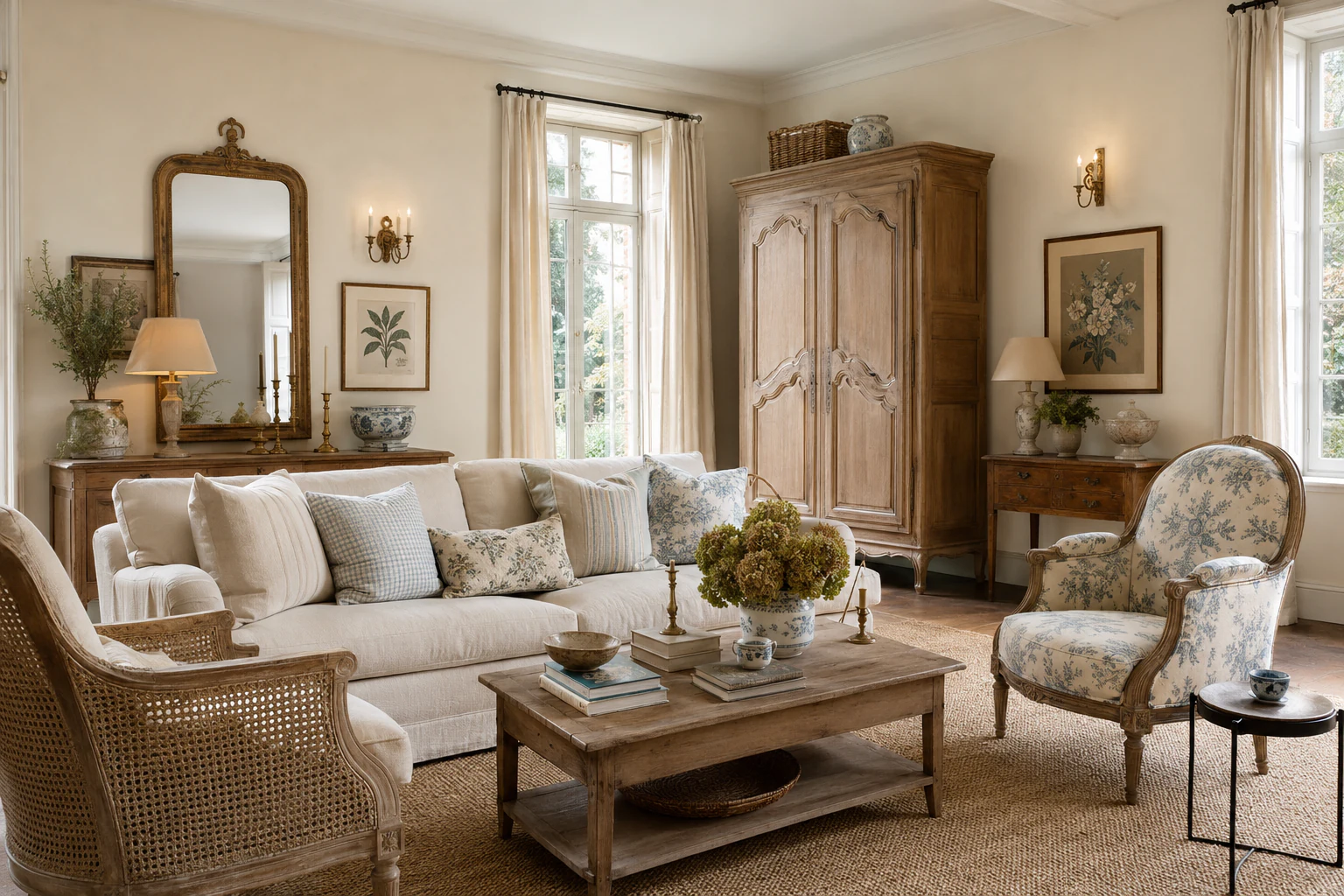
Choose a rug large enough for at least the front legs of the sofa and every main chair to sit on it. An 8×10 is a useful starting point for many living rooms, while larger or wider seating arrangements often need a 9×12 or 10×14.
The rug should connect the furniture rather than float like an island beneath the coffee table. Start with the seating footprint, then check that roughly 12 to 24 inches of visible floor remains around the rug where the room allows.
LIVING ROOM RUG SIZE CHART
Compare the most common sizes.
The furniture footprint matters more than the room label. Measure before buying, especially when the rug sits beneath a sectional or two facing sofas.
| Rug size | Best for | Typical furniture placement |
|---|---|---|
| 5×7 | Very compact seating nook | Usually floats inside the furniture; often too small |
| 6×9 | Small living room or apartment | Front sofa legs and possibly front chair legs on |
| 8×10 | Average living room | Front legs of all main seating comfortably on |
| 9×12 | Large room or sectional | Front legs on with generous side extension, or all legs on |
| 10×14 | Large or open-plan seating area | Entire furniture grouping can sit on the rug |
FOUR COMMON LAYOUTS
Fit the rug to the seating, not just the room.
In every layout, the rug should extend beyond the sides of the sofa and visually reach the chairs.
COMPACT ROOM
6×9
Place the front sofa legs on the rug and pull the chairs close enough for their front legs to join the same surface.
STANDARD ROOM
8×10
Let the rug extend past both sofa arms and support the front legs of every main seat.
LARGE ROOM
9×12 or 10×14
Use a generous rug that can hold the full grouping or leave substantial room behind the front legs.
SECTIONAL
Usually 9×12+
Cover the full inner seating zone and extend beyond both ends of the sectional so the rug does not look pinched.
HOW TO MEASURE
Map the rug before ordering.
Rug dimensions are difficult to judge from a small product image. Painter’s tape makes the scale obvious and helps catch blocked doors, vents, or narrow walkways.
Measure the seating footprint
Measure from the outer edge of the sofa to the farthest chair, not only the coffee table.
Add side extension
Aim for the rug to extend at least 6 inches beyond each sofa arm, and more when the room allows.
Tape the full outline
Mark every corner on the floor and walk the room before deciding between two sizes.
REAL-LIFE MATERIALS
Choose construction for the way the room is used.
Living-room rugs carry foot traffic, furniture weight, spills, pets, and everyday play. The right material can matter as much as the pattern.
Wool
Durable, soft, and naturally resilient. A strong choice for the main living room when you want long-term quality.
Washable or performance
Practical for young families, pets, and casual rooms. Check the care instructions and required rug-pad system.
Natural fiber
Jute and sisal add texture and work well alone or beneath a smaller patterned rug, though they can be rougher underfoot.
SHOP THE FLOOR
Four favorite places to start
Use the size filters first, then narrow by material, color, and pattern so you do not fall for a design unavailable in the dimensions your room needs.
Rugs Direct
A broad selection of traditional patterns and designer collaborations across many sizes.
Browse rugs →02Washable & practicalRuggable
Washable options for family rooms, pets, and high-traffic living spaces.
Browse rugs →03Colorful & classicAnnie Selke
Patterned, woven, and wool rugs with cheerful color and traditional character.
Browse rugs →04Tailored & relaxedSerena & Lily
Polished wool, natural-fiber, and patterned rugs with a light, tailored point of view.
Browse rugs →COMMON MISTAKES
Why a living room rug can feel too small
- Floating it under the coffee table.The rug separates from the seating instead of connecting it.
- Measuring the room only.The furniture footprint is the more useful starting point.
- Stopping at the sofa arms.A little extension beyond each end makes the rug feel properly scaled.
- Ignoring the chairs.Every main seat should touch the rug, even if only the front legs sit on it.
- Pushing it against the walls.Leave a visible floor border so the rug does not resemble wall-to-wall carpet.
- Skipping a rug pad.The right pad improves stability, comfort, and wear.
FREQUENTLY ASKED QUESTIONS
Living room rug sizing, answered.
What is the most common rug size for a living room?
An 8×10 rug is the most versatile starting point for many average living rooms. A 9×12 often works better in a larger room or with a wider seating arrangement, while a 6×9 can suit a compact living room.
Should a living room rug go under the sofa?
At minimum, the front legs of the sofa and main chairs should sit on the rug. In a larger room, placing all furniture legs on a larger rug creates an especially grounded, generous look.
Is a 5×7 rug too small for a living room?
A 5×7 rug is usually too small for a full living room seating group because it tends to float between the furniture. It can work in a very compact apartment arrangement, but a 6×9 or 8×10 often creates a more connected result.
How much floor should show around a living room rug?
Aim to leave roughly 12 to 24 inches of visible floor between the rug and the walls. Consistency matters more than achieving the exact same distance on every side.
What size rug works with a sectional?
Most sectionals need at least an 8×10 rug, and many look better on a 9×12 or 10×14. Choose a rug wide enough to reach under the front legs of the entire sectional and extend beyond the sides of the main seating area.