
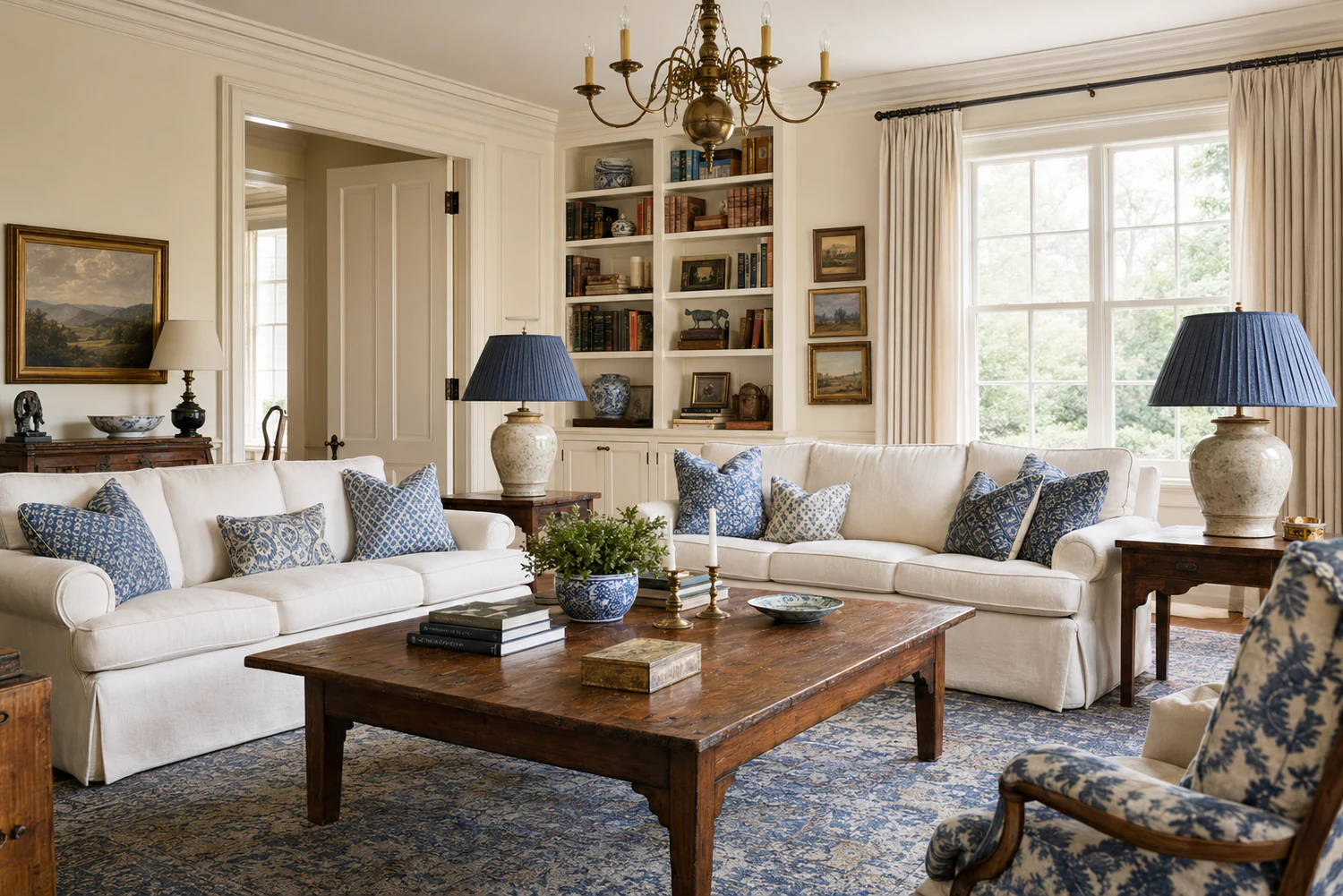
Hang the bottom of the artwork—or the lowest frame in a grouping—about 6 to 10 inches above the top of the sofa. Seven to eight inches is the most reliable starting point for keeping the art visually connected to the furniture.
The common mistake is not usually hanging art an inch too low; it is hanging it so high that the sofa and artwork feel unrelated. Treat them as one composition. Start with the space above the sofa, then use eye level and the rest of the wall as secondary checks. If you are still choosing the piece, first find the right artwork width for your sofa.
THREE COMMON ARRANGEMENTS
Measure the grouping as one piece.
The bottom edge of a single painting, a pair, or an entire gallery wall should begin within the same general range above the sofa.
ONE LARGE PIECE
Use the bottom edge
Measure from the top of the sofa to the bottom of the frame. Center the artwork on the sofa rather than automatically centering it on the whole wall.
A PAIR
Keep the bottoms aligned
Treat the pair as one wide composition. Align the lower edges and keep the space between the frames tighter than the space between the art and sofa.
A GALLERY WALL
Find the lowest frame
Build the grouping on paper first, then measure from the sofa to the bottom of the lowest frame. Keep roughly 2 to 3 inches between neighboring frames.
THE EXACT METHOD
How to calculate the nail height
Example: A 34-inch sofa back + an 8-inch gap + 22 inches from the bottom of the frame to the tensioned wire = a nail placed 64 inches from the floor.
Mark the bottom edge
Measure 7 to 8 inches above the highest point of the sofa back and mark the intended bottom of the frame with painter’s tape.
Measure the real hardware
Pull the picture wire upward as it will sit on the hook, then measure from that point to the bottom of the frame. For D-rings, measure to the ring or hook location.
Tape the whole outline
Use painter’s tape or a paper template to see the complete scale from across the room before making a hole.
SOFA RULE VS. EYE-LEVEL RULE
Above furniture, the relationship wins.
The familiar 57-to-60-inch rule is most useful on an open wall. Above a sofa, begin with the furniture instead. If the artwork is connected to the sofa but its center lands a little above or below 57 inches, that can still be the better placement.
Step back into the doorway and look at the sofa and artwork together. The composition should feel grounded in the lower half of the wall, not pulled upward by the ceiling.
WHEN TO ADJUST
The measurement is a starting point, not a law.
A very tall sofa back
Stay closer to 6 inches so the combined sofa-and-art composition does not climb too high. Sit on the sofa and confirm that heads cannot touch the frame.
A low-profile sofa
A slightly larger gap can work, but resist using the wall’s midpoint as the only guide. The artwork should still belong visually to the seating area.
Tall ceilings
Do not raise the art simply to fill the wall. Choose a taller piece, a stacked arrangement, or a larger grouping while keeping its lowest edge tied to the sofa.
A picture light
Plan the fixture and artwork together. Leave enough space above the frame for the light, but do not push the entire composition higher than the sofa relationship allows.
SHOP THE WALL
Four favorite places to start
Look for artwork with enough scale and presence to hold the wall above a sofa—whether that means a vintage oil, an original painting, or a beautifully framed print.
1stDibs
A wide-ranging source for original paintings, works on paper, photography, and collectible art.
Browse art → 02 Curated original artTappan Collective
Emerging artists and original work with a polished, editorial point of view.
Browse art → 03 Framed prints & pairingsArtfully Walls
Colorful framed prints and easy pairings that still feel thoughtfully collected.
Browse art → 04 Vintage & independentEtsy
An approachable place to uncover vintage oils, original work, and independent artists.
Browse art →COMMON MISTAKES
Why art above a sofa can feel off
- Hanging it too high.The artwork feels like it belongs to the ceiling rather than the furniture.
- Centering on the wall.If the sofa is off-center, the artwork should usually follow the seating—not the drywall.
- Ignoring the frame hardware.Wire drop and D-ring placement change the nail height, sometimes by several inches.
- Spacing a pair too far apart.The gap between frames should be smaller than the gap between the grouping and sofa.
- Letting ceiling height take over.A tall room needs appropriately scaled art, not artwork floated far above the sofa.
- Skipping the seated view.Check comfort and clearance from the sofa before committing to the hardware.
FREQUENTLY ASKED QUESTIONS
Art placement, answered.
How far above a sofa should art be hung?
Leave about 6 to 10 inches between the top of the sofa and the bottom of the frame or artwork grouping. Seven to eight inches is an easy starting point in most living rooms, then adjust slightly for the sofa back, artwork height, and nearby architecture.
Should art be centered on the wall or the sofa?
When artwork hangs directly above a sofa, center it on the sofa or the main seating arrangement rather than automatically centering it on the entire wall. The furniture and art should read as one composition.
Does the 57-inch rule apply above a sofa?
Use 57 to 60 inches from the floor to the center of the art as a secondary check, not the primary rule. Above a sofa, maintaining a visual connection to the furniture usually matters more than forcing the center to a fixed height.
How high should a gallery wall start above a couch?
Treat the gallery wall as one large piece and place the bottom of the lowest frames about 6 to 10 inches above the sofa. Keep the spaces between frames consistent, usually around 2 to 3 inches for a tight, collected arrangement.
Should art be hung higher with tall ceilings?
Usually not. Tall ceilings do not require art to float higher above the sofa. Keep the artwork connected to the furniture and fill additional wall height through the scale or shape of the composition rather than raising the entire arrangement.
How high should art hang above a sectional?
Use the same 6-to-10-inch starting range, measuring above the section of the back that visually anchors the artwork. Center the art on the longest uninterrupted section or on the overall seating composition, depending on the room layout.