
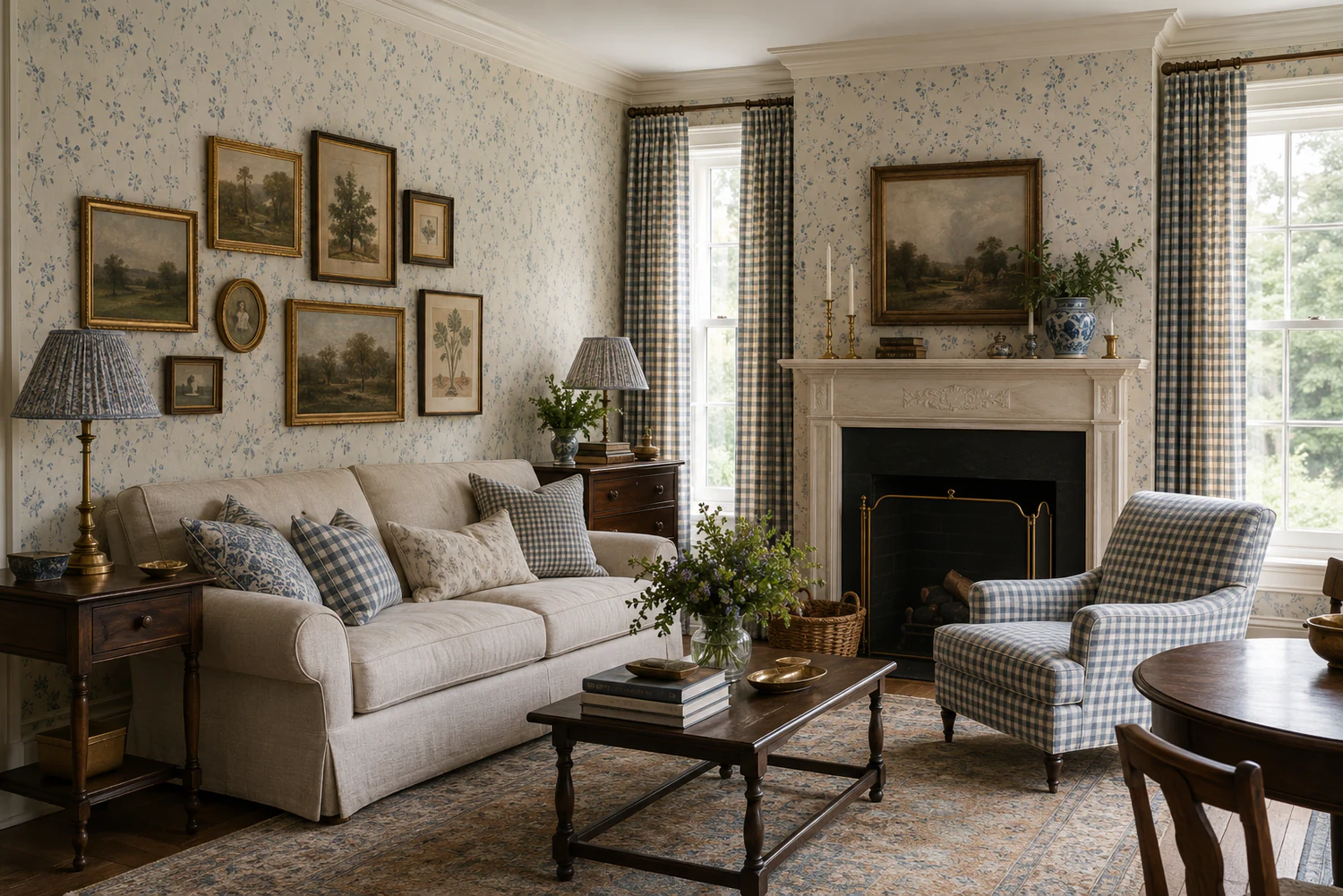
Choose artwork, or a complete grouping, that is roughly two-thirds to three-quarters the width of your sofa. Measure the full outer width, including frames and the spaces between multiple pieces.
That range is large enough to anchor the seating area without making the art feel as heavy as the sofa itself. Once the scale is right, use the companion guide to decide how high to hang art above your sofa.
SOFA-TO-ART SIZE CHART
Find your range at a glance.
These measurements apply to the total outside width of a single framed work, a pair, a triptych, or a gallery wall.
| Sofa width | Recommended art width | Easy target |
|---|---|---|
| 60 inches | 40–45 inches | About 42 inches |
| 72 inches | 48–54 inches | About 51 inches |
| 78 inches | 52–59 inches | About 55 inches |
| 84 inches | 56–63 inches | About 60 inches |
| 90 inches | 60–68 inches | About 64 inches |
| 96 inches | 64–72 inches | About 68 inches |
FOUR WAYS TO FILL THE WIDTH
Measure every arrangement as one piece.
A single large work is not the only way to reach the right scale. The outside edges of the entire composition are what matter.
ONE LARGE PIECE
Let one frame anchor the wall
Use the frame’s full outer width, not just the visible image or canvas.
A PAIR
Include the center gap
Measure from the outside of the first frame to the outside of the second.
A TRIPTYCH
Keep the spacing consistent
The three frames and both gaps should fit within the recommended total width.
A GALLERY WALL
Use the outermost edges
Treat the full arrangement like one large, irregularly shaped work of art.
HOW TO MEASURE
Test the scale before you buy or hang.
A few minutes with a tape measure and painter’s tape can prevent an undersized piece from feeling lost once it reaches the wall.
Measure the sofa
Measure from the outside of one arm to the outside of the other. Use the main seating span for a sectional.
Calculate the range
Multiply the sofa width by .67 and .75. This gives you a flexible minimum and maximum rather than one rigid number.
Count frames and gaps
For multiple pieces, add every frame width and each space between them to get the total composition width.
Tape the outline
Mark the full outer boundary on the wall and view it from the room’s main entrance and seating positions.
WHEN TO ADJUST
Follow the visual center of the seating.
The proportion is a guide, not a demand for perfect symmetry. Architecture, asymmetrical furniture, and the shape of the art can all shift the final composition.
- A sectional or chaiseCenter the art on the main uninterrupted seating area, not necessarily the sectional’s entire footprint.
- A tall, narrow workPair it with another piece or build a small grouping if it cannot reach enough width on its own.
- An off-center sofaCenter the art on the sofa rather than the wall so the furniture and artwork read together.
- A lamp or side table nearbyLet the full room composition breathe. The art can shift slightly if the surrounding pieces create a stronger balance.
SHOP THE WALL
Four favorite places to start
Search by dimensions whenever possible, and remember that a pair or grouping can create the presence of one larger piece.
1stDibs
A wide-ranging source for original paintings, works on paper, photography, and collectible art.
Browse art → 02 Curated original artTappan Collective
Emerging artists and original work with a polished, editorial point of view.
Browse art → 03 Framed prints & pairingsArtfully Walls
Colorful framed prints and easy pairings that still feel thoughtfully collected.
Browse art → 04 Vintage & independentEtsy
An approachable place to uncover vintage oils, original work, and independent artists.
Browse art →COMMON MISTAKES
Why the artwork can still feel too small
- Measuring the image, not the frame.The full outside edge is the width your eye reads on the wall.
- Leaving gaps that are too wide.Large spaces make a pair or gallery wall break apart into unrelated pieces.
- Choosing width without height.A very wide but extremely short work may still lack enough visual presence.
- Centering on the entire wall.The art should usually relate to the sofa, especially when the sofa sits off-center.
- Buying small art without a plan.Small pieces can work beautifully when intentionally grouped into a larger composition.
- Ignoring nearby objects.Lamps, sconces, windows, and side tables all affect how much visual space the art occupies.
FREQUENTLY ASKED QUESTIONS
Art sizing, answered.
What size art should go above an 84-inch sofa?
For an 84-inch sofa, aim for artwork or a complete grouping that is about 56 to 63 inches wide. This follows the two-thirds to three-quarters guideline and includes the frame and any gaps between multiple pieces.
Should art be the same width as the sofa?
Usually not. Artwork that is exactly as wide as the sofa can make the arrangement feel top-heavy. A width of about two-thirds to three-quarters of the sofa generally feels more balanced.
Does the frame count when measuring art above a sofa?
Yes. Measure the full outer width of the framed piece. For a pair or gallery wall, measure from the outside edge of the first frame to the outside edge of the last, including the gaps.
How wide should a pair of pictures be above a sofa?
The combined outer width of both frames and the gap between them should be about two-thirds to three-quarters of the sofa width. Keep the gap relatively tight so the pair reads as one composition.
How high should art hang above a sofa?
Leave about 6 to 10 inches between the top of the sofa and the bottom of the artwork or grouping. Seven to eight inches is a reliable starting point in most rooms.